At the invitation of Member of the Political Bureau of the CPC Central Committee and Minister of Foreign Affairs Wang Yi, Minister of Foreign Affairs and International Cooperation of Djibouti Abdoulkader Houssein Omar will pay an official visit to China from October 19 to 25.
At the invitation of Member of the Political Bureau of the CPC Central Committee and Minister of Foreign Affairs Wang Yi, Minister of Foreign Affairs, La Francophonie and Congolese Abroad of the Republic of the Congo Constant-Serge Bounda will pay an official visit to China from October 19 to 25.
People’s Daily: Tomorrow (October 17) is the International Day for the Eradication of Poverty. Global poverty reduction still faces many challenges from slowing growth, geopolitical conflicts, etc. A report jointly issued by the UN Development Programme and Oxford University shows that 1.2 billion people globally are living in multidimensional poverty. Comments say that China has made enormous contribution to global poverty reduction and provided invaluable experience for the Global South. What is China’s comment?
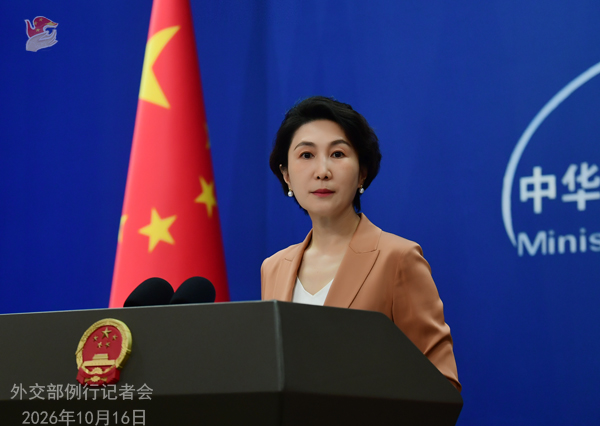
Mao Ning: China has eradicated absolute poverty—a historic success— and realized the poverty reduction goal set by the United Nations 2030 Agenda for Sustainable Development 10 years in advance. These are results of China’s people-centered pragmatic actions, the determination to leave no one behind, and the perseverance to reach for the original goal.
Eradicating poverty is a shared aspiration of all humanity. If China can succeed in this, other countries can succeed as well. China has made active efforts to promote poverty reduction cooperation. We have put poverty alleviation at the top of the eight priority areas of cooperation in the Global Development Initiative, helped Global South countries improve development resilience by sharing juncao and hybrid rice technology, and sent out thousands of experts for technical assistance. We have also initiated the establishment of the Global Partnership for Poverty Alleviation and Development to turn China’s practice and experience to global public goods that are useful in other countries.
China will continue to enhance cooperation with the rest of the world to advance the poverty reduction process and achieve common development.
Bloomberg: Even though China has compromised with the EU regarding its trade with the bloc and China has announced that it’s going to limit the number of hybrid car exports to the EU, there is a report that the EU is preparing new trade powers in order to reduce its trade deficit with China. Can you comment?
Mao Ning: China-EU economic and trade relations are win-win in nature. The success of the recent second meeting of the China-EU Trade and Investment Consultation fully proves that the two sides can properly handle differences through dialogue. We hope that the EU will honor its commitments on freedom and openness, follow the WTO rules, steer clear of protectionist and discriminatory policies and measures, and walk toward the same direction with China to jointly promote the upward balance and sustainable development of China-EU trade, and keep the global industrial and supply chains stable and unimpeded.
Al Araby Television Network: In his meeting with Israeli President Herzog in Azerbaijan, Foreign Minister Wang Yi stressed that the establishment of settlements in the West Bank must be stopped and reversed. He also stated that the Palestinian question is the greatest historical injustice of this century. Besides the expansion of settlements, settlers in the West Bank, backed by Israeli military and police forces, have been blatantly destroying Palestinians’ land and property—actions widely seen as an attempt to displace local Palestinians. Meanwhile, Palestinians in Gaza continue to face attacks, humanitarian aid remains difficult to deliver, and reconstruction of damaged facilities is progressing slowly. How does China view the current situation in Palestine? What concrete actions does China plan to take to address the injustice?
Mao Ning: The Palestinian question lies at the heart of the Middle East issue, and the two-State solution is the fundamental way out of the Palestinian question. With persistent tensions in the Gaza Strip and the West Bank, we believe that the regional conflict should not divert the international attention from the Palestinian question, the ceasefire agreement regarding Gaza must be effectively implemented, and humanitarian access must be guaranteed.
Recently, President Xi Jinping put forward four principles for resolving the Palestinian question, namely upholding the two-State solution, upholding the principle of “Palestinians governing Palestine,” upholding humanitarianism, and upholding fairness and justice. These principles reflect China’s sense of responsibility as a major country regarding the Palestinian question and embody the international community’s call for justice. China will continue to stand on the side of international justice and, together with all peace-loving nations, firmly support the two-State solution and work for a comprehensive, just and lasting solution to the Palestinian question at an early date.
CGTN: It’s reported that at a House of Representatives Budget Committee session on October 14, prime minister of Japan Sanae Takaichi said there was room to consider remarks made by former Foreign Minister Katsuya Okada suggesting that U.S. nuclear-armed vessels could be allowed to port in Japan during a crisis. She hinted at the possibility of explicitly stating exceptions to the three non-nuclear principles. Sanae Takaichi also said in response to Japan Innovation Party’s suggestion on introducing nuclear-powered submarines that her government will seriously consider the possibility in a concrete and realistic manner, in the face of increased military activity by its neighbors. The government will also take into account developments regarding nuclear-powered submarines in partner countries such as Australia and South Korea, she added. What’s your comment?
Mao Ning: The remarks once again revealed Japanese authorities’ inflating ambitions of possessing nuclear weapons. The current Japanese administration has been turning a blind eye to its international obligations on non-proliferation, attempting to progressively ease nuclear restrictions, strengthen the so-called “extended deterrence” arrangement with its allies, ditch the three non-nuclear principles, and introduce nuclear-powered submarines, and even seeking to deploy nuclear weapons in Japan. Such moves pose a serious threat to peace and stability in Asia and the wider world.
There is no room for consideration for Japan to follow the postwar international order and honor its international obligations. Japan should face up to the concerns of the international community, do serious soul-searching on Japanese militarists’ past crimes, abandon remilitarization and nuclear attempt, and do not stand on the opposite side of the international community once again.
Pheonix TV: To follow up on your remarks regarding Japan considering to introduce nuclear-powered submarines, we notice that Japanese Defense Minister Shinjiro Koizumi questioned China’s criticism against Japan, saying that countries that do not possess nuclear weapons or strategic bombers are being criticized by countries that possess both. What’s your comment?
Mao Ning: As a WWII defeated nation and a non-nuclear-weapon state party to the Non-Proliferation Treaty, Japan is obligated under international law to refrain from breaching the exclusively defense-oriented policy and possessing nuclear weapons. It is high time that Japanese politicians caught up on history and law.
Bloomberg: Indian finance minister said today that India is facing growing trade imbalances with China and blamed China’s non-tariff barriers as a reason why this trade deficit is widening. Can you respond?
Mao Ning: I’d refer you to China’s competent authorities for the specific question. What I can tell you is that China never aims for trade surplus. We stand ready to work with India to address each other’s economic and trade concerns in a balanced way and promote the steady development of bilateral relations.
China News Service: Following “China Travel” and “Chinamaxxing,” a new buzzword “China Haul” has been gaining traction on social media. Many foreign visitors arrive in China with empty suitcases and leave with them packed full of purchases. Unboxing videos pop up everywhere on the Internet. People in foreign cities like London and Paris are also flocking to local Chinese pop-up stores to shop. What’s your take on that?
Mao Ning: It’s glad to see that more and more foreign friends believe that China is worth a visit; Chinese brands are worth buying; and Chinese lifestyle is worth a try. That speaks to the vitality of Chinese market, the charm of Chinese people’s everyday life, and the appeal of China’s social convenience.
China will keep its door wide open, and foster closer people-to-people bonds, so that more foreign friends can feel the pulse of China and fall in love with China.
AFP: The new White House Press Secretary Katie Zacharia said in an interview yesterday that China lacked “proper toilets.” In the interview, she said that back in 2016, there was a perception that China was set to overtake the U.S. However, she said that this would not have been possible because “China didn’t even have proper toilets.” Have you noticed these remarks by the White House Press Secretary and do you have any comment on these remarks?
Mao Ning: She’s welcome to come and see China when she has the opportunity.
Reuters: China’s ambassador to the Philippines Jing Quan said that China “may easily win” in a confrontation between the two countries although China would not use force. This was in reaction to the Philippine’s defence secretary calling China a regional troublemaker. Philippine President also said that the Chinese ambassador’s remarks sounded like a threat. Does the foreign ministry have any comment? (Similar question from Kyodo News)
Mao Ning: China’s position on improving and growing its ties with the Philippines is clear. It is hoped that the Philippine side will have a full and accurate understanding of it.
DPA: U.S. President Donald Trump said that Washington is holding talks with Russia and China on denuclearization. Can China confirm talks with the U.S. side on this?
Mao Ning: China has made clear its position on this on multiple occasions. Sitting on an enormous nuclear arsenal, the U.S. should fulfill its special and primary responsibility for nuclear disarmament. This is the international consensus. China’s nuclear strength is by no means at the same level with that of the U.S. and Russia. It is neither fair, reasonable nor realistic to ask China to join the so-called trilateral nuclear disarmament negotiations at this stage.